
Service
Technical consulting for decisions that are expensive to reverse
Architecture reviews, stack choices and build-versus-buy calls from engineers who ship. You get a written recommendation, not a slide deck of options.
The most costly software mistakes are made before anyone opens an editor: picking a platform that cannot scale with the business, accepting a vendor quote built on guesses, or committing to a rewrite when a focused fix would do. Technical consulting is for the moment when you need someone knowledgeable and independent to look at the choice with you.
Our consulting is practical. We read your code or your requirements, talk to the people who run the system, and write a recommendation with the reasoning visible: what we would do, what we would avoid, what is uncertain and what it would cost to be wrong. If the best advice is to buy a product off the shelf, or to leave the system alone, that is what the report says.
Engagements are short and bounded, usually a few days to a few weeks. You can use the output to brief your own engineers, evaluate competing proposals or decide whether to continue with us. We do not make advice conditional on a build contract.
The problems
What usually goes wrong
Competing proposals you cannot compare
Three vendors quote three different architectures at three different prices, and none of them explains the trade-offs in terms you can weigh.
A stack chosen by whoever was available
Early shortcuts hardened into the foundation. Now each new feature fights the architecture and nobody is sure whether to patch or replace.
Build-versus-buy paralysis
Every off-the-shelf tool does eighty percent and every custom build sounds expensive. Without a framework, the decision drifts for months.
Risk you cannot see yet
Security gaps, scaling cliffs, single points of failure and vendor lock-in are invisible until the day they matter, which is the worst day to find them.
What you get
Deliverables
Written recommendation
A clear position on the decision, with the reasoning, assumptions and unknowns laid out so your team can challenge it.
Architecture review
A look at structure, data model, integrations, deployment and failure modes, with findings ranked by consequence.
Build-versus-buy analysis
Candidate products and custom options compared against your actual workflow, including integration cost and exit options.
Vendor proposal review
A line-by-line read of another vendor's estimate or statement of work, flagging gaps, hidden assumptions and unrealistic dates.
Risk register
Security, scalability, operational and dependency risks with a suggested response for each, in plain language.
Roadmap and next steps
A sequenced plan for what to do first, what to defer and what to stop doing, sized so you can budget it.
How it works
Step by step
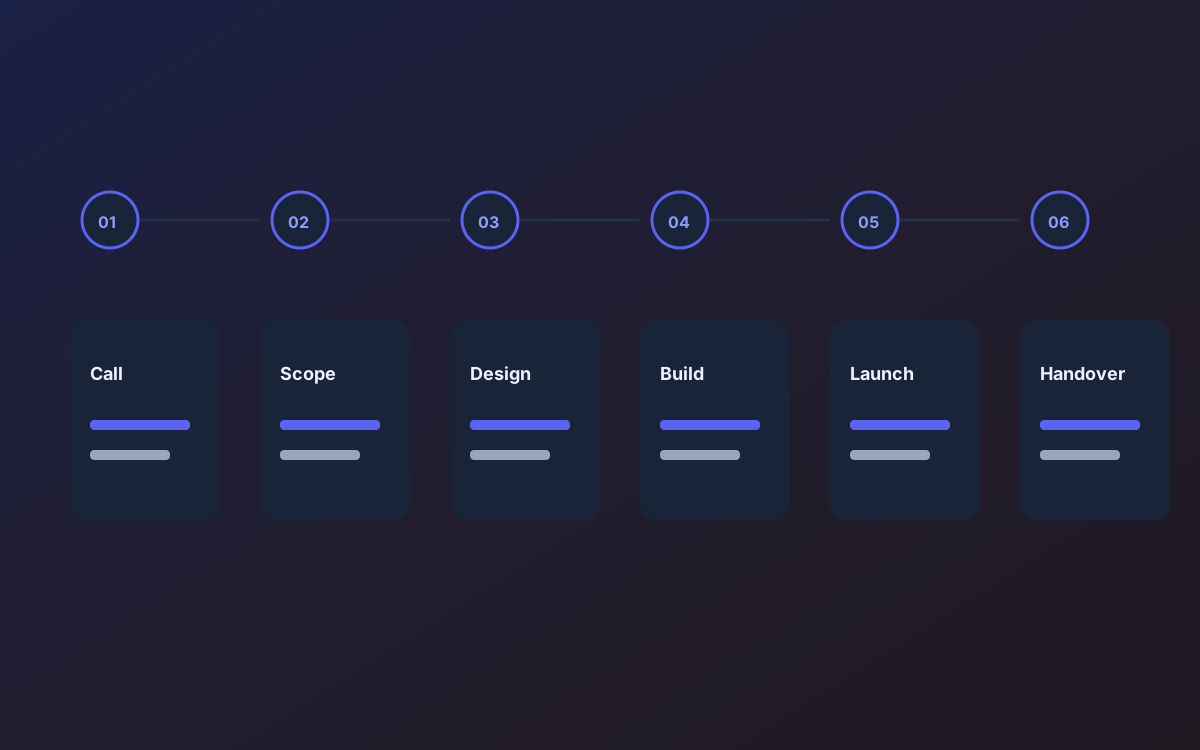
01
Frame the question
We agree on the exact decision at stake, who it affects, what constraints are fixed and what a useful answer looks like.
02
Gather evidence
We read the code, documents and proposals, and speak with the engineers, operators and stakeholders who know where the problems are.
03
Analyze options
We compare realistic options against your constraints, including doing nothing, and test the riskiest assumptions with small experiments where needed.
04
Present the recommendation
A live walkthrough of the findings with time for challenge, followed by the written document.
05
Support the decision
We answer follow-up questions while you decide, and can help brief your team or another vendor if you proceed elsewhere.
06
Revisit when facts change
Assumptions shift as vendors reply and budgets move. We offer a short follow-up review once you have acted, to check whether the recommendation still holds and whether early results match what we expected.
Timeline
How long it typically takes
A focused question, such as reviewing a vendor proposal or comparing two platforms, often takes a few days. A full architecture review of an existing system more commonly takes one to three weeks depending on size and access. We confirm the timeframe and fee before starting so the advice itself has no open-ended meter running.
Who it's for
- Leaders comparing vendor proposals who need an independent technical read
- Founders choosing a stack or platform before committing to a build
- Teams weighing a rewrite against incremental fixes on an existing system
Who it's not for
- Buyers who want us to execute immediately rather than decide first
- Teams looking for a rubber stamp on a decision already made
- Organizations that need legal, tax or regulatory opinions we are not qualified to give
Keep exploring
Related pages
FAQ
Frequently asked questions
Do you have to win the build to give advice?
No. Consulting is priced and delivered on its own. Our recommendations are not conditional on a build contract, and the report is yours to use with anyone.
Will you review code from another vendor?
Yes. We read it under NDA and give an honest assessment, including what is well done. We do not manufacture problems to justify a rewrite.
Can you review a proposal we received?
Yes. Send the estimate or statement of work and your requirements, and we will flag unclear assumptions, missing pieces and dates that look optimistic.
What access do you need?
Read-only access to the repository and documentation is usually enough, plus conversations with the people who run the system. We avoid production credentials unless the question demands them.
Is the output only advice, or can you help carry it out?
The deliverable is advice. If you want help executing, we can scope that separately as a project, retainer or dedicated developer engagement, but there is no obligation.
Can you work with non-technical decision makers?
Yes. Findings are written for executives first and engineers second, with a plain-language summary at the top and the technical detail underneath for anyone who wants to check our reasoning.
Next step
Tell us what you want to build
A short call, then a written scope in plain language before any build starts.
- Fixed scope
- Weekly demos
- You own the code