
AI service
Turn documents and inboxes into structured, checked data
Invoices, applications, contracts and emails read, classified and entered into your system, with validation rules and a review screen for anything uncertain.
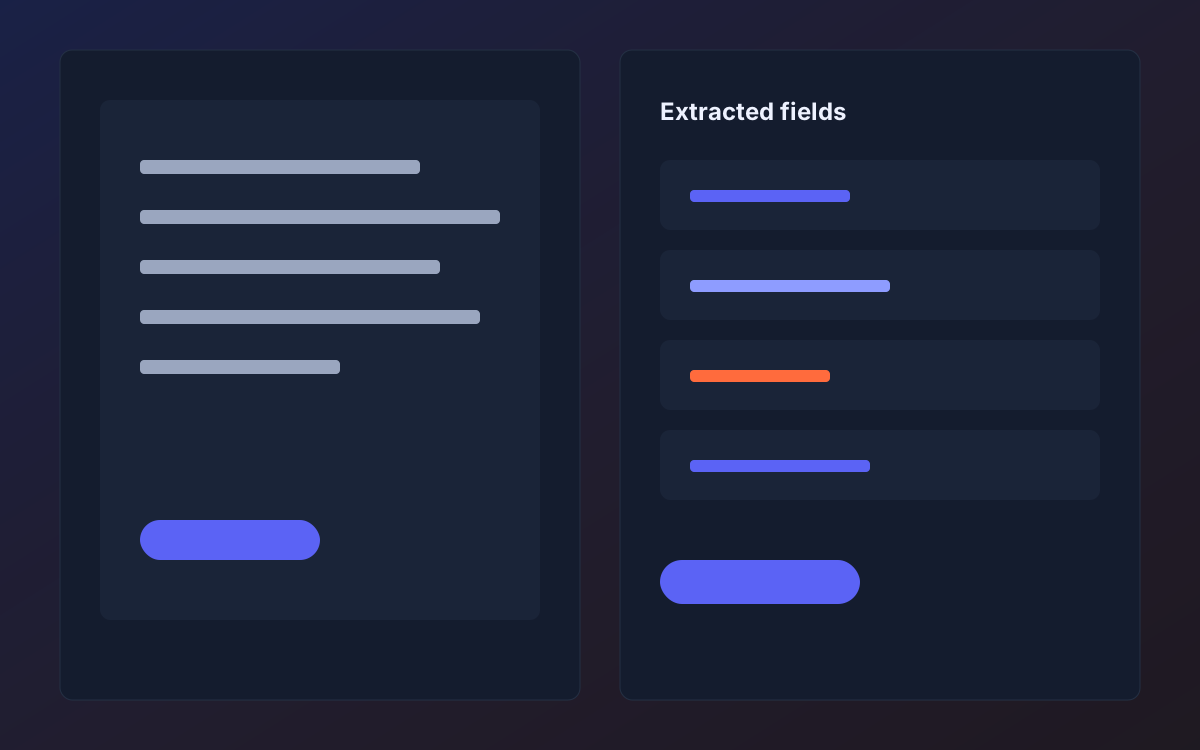
Somewhere in your business a person is reading a PDF and typing numbers into a screen. It might be supplier invoices, loan applications, delivery notes, onboarding forms or contract terms. The work is tedious, error-prone and scales with volume, which means growth makes it worse. It is also the kind of work language models and document parsing can handle well when the pipeline is designed with care.
A document pipeline is more than extraction. Files arrive in different formats and quality, so we classify them first. We extract the fields you care about, validate them against rules such as totals that must add up or dates that must make sense, and compare them with your existing records. Anything uncertain goes to a review screen that shows the source side by side with the extracted values, so a person corrects it in seconds.
Corrections feed back as test cases, which lets you see how accuracy changes when you update prompts or switch models. Results land in your system of record through its API, with a link to the original file for audit. We avoid promising a headline accuracy figure because it depends on your documents, and we measure it on a sample of yours before launch.
The problems
What usually goes wrong
Manual data entry that scales with volume
Every extra invoice or application means more typing. Hiring to keep up is expensive and the error rate rises as people tire.
Documents in every shape
Scans, photos, native PDFs and email attachments from many senders defeat template-based tools that expect one fixed layout.
Errors that surface late
A wrong amount or a misread name travels downstream into payments and reports, and gets found weeks later when it is costly to fix.
No audit trail back to the source
Once data is typed in, nobody can easily trace a value to the page it came from, which complicates disputes and reviews.
What you get
Deliverables
Document intake pipeline
A single entry point for uploads, email and shared folders, with file checks and queuing for reliable processing.
Classification and extraction
Automatic identification of document types and extraction of the fields and line items you define, including tables.
Validation and matching rules
Checks for totals, formats, duplicates and matches against purchase orders, customers or other records already in your systems.
Human review screen
A side-by-side view of the document and extracted values, with confidence flags and quick correction for exceptions.
Export to your systems
Clean data delivered into your ERP, CRM, accounting or database through APIs, with the source file linked to each record.
Accuracy report on your documents
A measured comparison of extraction against a sample you have verified, repeated when models or prompts change.
How it works
Step by step
01
Collect representative samples
We gather a realistic spread of your documents, including the messy ones, and define the fields and rules that matter.
02
Prototype extraction
We run the samples through a working pipeline and compare the results with values your team has verified.
03
Design review and exceptions
We set confidence thresholds and build the review screen so uncertain items go to a person and clear ones flow through.
04
Integrate with your systems
We connect the output to your system of record and test the full path with real volumes and edge cases.
05
Pilot and tune
A small stream of live documents runs in parallel with the manual process until the results are trusted, then volume increases.
Timeline
How long it typically takes
A pipeline for one or two document types with a review screen and an export to a single system often takes four to eight weeks from approved scope. Many document types, multiple languages or complex matching rules extend this to two to four months. Collecting representative samples early is the biggest factor in staying on schedule.
Who it's for
- Finance and operations teams processing invoices, forms or delivery paperwork at volume
- Businesses whose staff spend a large part of the week retyping documents
- Firms that need a traceable link between each data point and its source file
Who it's not for
- Teams with a handful of documents a month, where manual entry is cheaper
- Cases that require legal certification of the extraction with no human check
- Documents so poor or inconsistent that a person cannot read them reliably either
Honest scoping
Where AI helps, and where it doesn't
Where AI helps
- Supplier invoices, receipts and purchase orders with varied layouts
- Application and onboarding forms that need entry into a system
- Contracts and letters where specific terms or dates must be pulled out
- Shared inboxes where attachments need sorting and routing
Where it doesn't
- Very low volumes where setup cost outweighs the saved time
- Documents where any error carries serious legal or safety consequences without review
- Handwriting or images that people themselves cannot read reliably
- Cases where a structured data feed from the sender is available instead
Data privacy
Your data stays yours
Your documents often contain sensitive information, so we design the data flow before writing code. Processing uses your own provider keys, files are stored in your cloud account, and credentials are encrypted at rest. We do not train models on your documents through our application layer, and provider-side terms for your keys still apply. Retention is configurable, so files and extracted data can be deleted on a schedule you choose.
How we handle security →Keep exploring
Related pages
FAQ
Frequently asked questions
How accurate is the extraction?
It depends on your documents, so we measure it rather than quote a generic figure. We test against a verified sample of yours before launch and report where the pipeline is strong and where a person must check.
Do you need templates for each supplier?
Usually not. Language models handle varied layouts well, though we still validate the output with rules. Highly regular documents can use simpler parsing alongside the model to reduce cost.
What happens with uncertain results?
They go to the review screen with the document alongside. A person confirms or corrects the values, and the correction is saved as a test case to improve the pipeline.
Can it read scans and photographs?
Yes, within limits. Image quality affects results, so we test with your real scans and recommend capture guidelines if needed, such as resolution or lighting for phone photos.
Where do the documents go?
To the model provider you choose through your own key, and to storage in your environment. We document the data flow so your security or legal team can review it before launch.
Next step
Tell us what you want to build
A short call, then a written scope in plain language before any build starts.
- Fixed scope
- Weekly demos
- You own the code